
If you wake with a stiff neck, or you catch yourself sliding a hand under the pillow at night, or you fold the pillow in half to prop your head higher — the pillow you're sleeping on isn't the right one for you.
This isn't really about good pillows and bad pillows. The right pillow for you depends on one thing above all others: the position you sleep in.
A pillow's job is to fill a gap
That's the whole principle in a sentence. When you lie down, a gap opens between your head and the mattress. The pillow's job is to fill exactly that gap, so your neck stays in line with the rest of your spine.
Too little pillow and your head drops, bending your neck one way. Too much and your head lifts, bending it the other.
Either way you wake up sore. And how big that gap is depends entirely on how you sleep.
Side sleeping: the biggest gap
Lying on your side, the distance between your ear and the mattress is the width of your shoulder — the largest gap of any position. That means you need the highest, firmest pillow of anyone.
It's also the most common sleeping position, and the one where people most often under-buy.
The clearest sign your pillow is too low: you find your hand or forearm tucked underneath it. Your body is making up the missing height on its own.
Of the three fill weights we make, 1500g is the natural starting point for most side sleepers, particularly if you're broad across the shoulders.
Back sleeping: a middling gap
On your back, the gap between the back of your head and the mattress is much smaller than on your side. You want a medium height — enough to support the natural curve of the neck without pushing your head forward.
A quick check: lie on your back and have someone look at you from the side. If your chin is tipped up towards the ceiling, the pillow is too low. If your chin is heading towards your chest, it's too high.
1300g is usually the right territory.
Front sleeping: as little as possible
Sleeping on your front, your head is already almost flat against the mattress, so there's barely a gap at all. Any real height twists your neck upwards for hours.
You want the lowest, softest pillow you can find — 1100g or less — and plenty of front sleepers are most comfortable with no pillow under the head at all, using one under the hips instead.
It's worth saying plainly: front sleeping is the hardest position on your neck, because you have to turn your head ninety degrees to breathe and hold it there for hours. If your neck troubles you and you sleep on your front, a thinner pillow will help, but the thing that actually helps is training yourself onto your side.
What if you move around all night?
Most people do. What matters is the position you spend the most time in, which is usually the one you fall asleep in and the one you wake up in. Choose for that.
If you genuinely split your time between side and back, take the middle — 1300g — as the compromise that won't hurt you in either.
Fibre or memory foam? In Egypt that's a different question
Both work well, and the real difference here isn't comfort. It's heat.
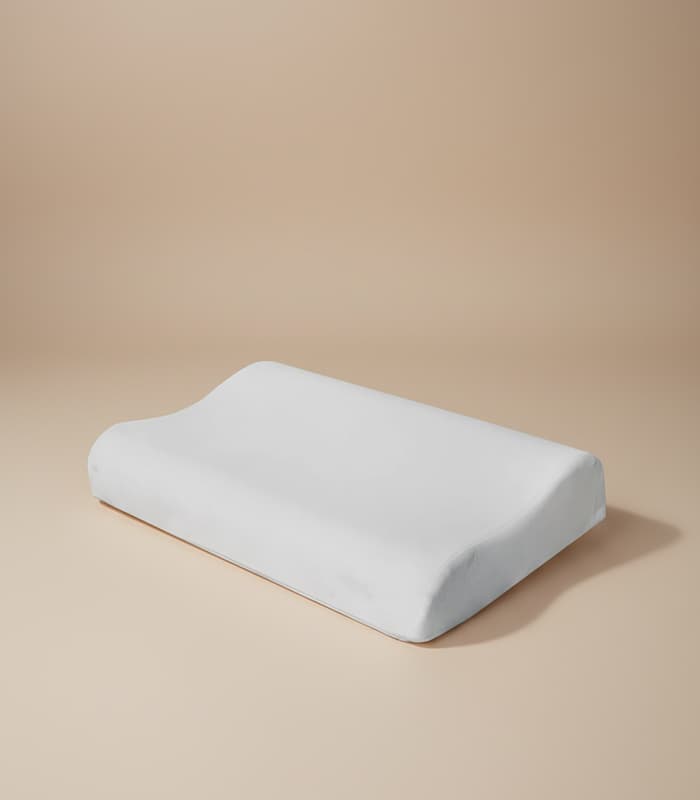
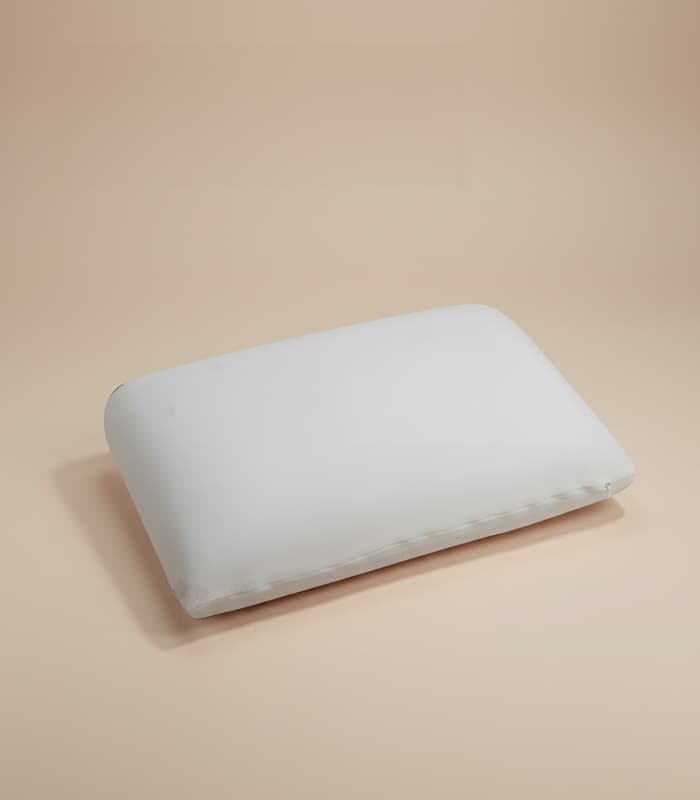
Memory foam moulds precisely to your head and neck, and its support is excellent if you have neck problems. The catch is that it's a solid block: it traps body heat and is slow to release it. In a Cairo winter that's a feature. In July without air conditioning, it's the thing that wakes you.
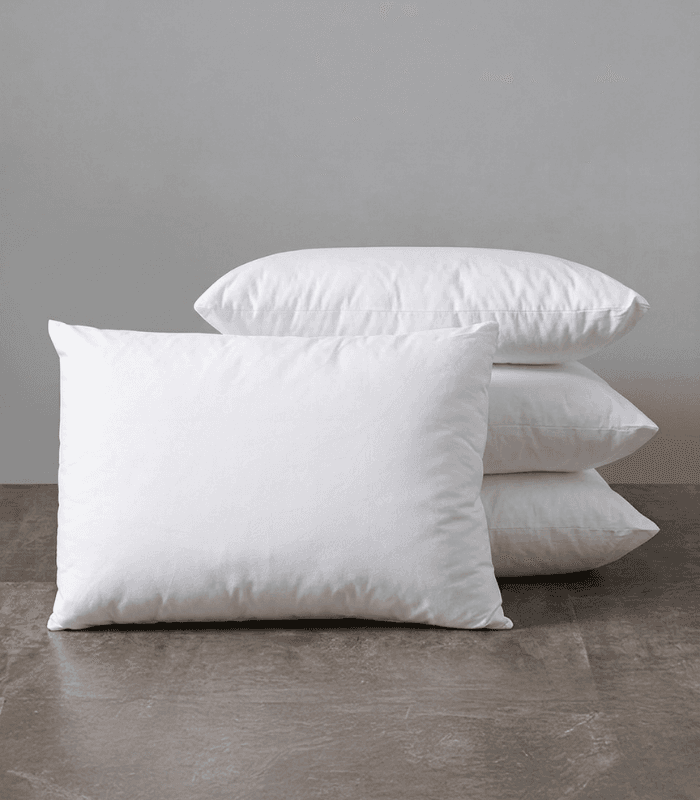
Fibre fill lets air move through it, so it stays noticeably cooler, and it washes and recovers its shape. Its support is less precisely contoured than memory foam, though for most people that difference is academic.
The practical rule: if you sleep in an air-conditioned room year round, either works. If you sleep without air conditioning for part of the year — as most people do — fibre will treat you better in summer.
Signs your pillow is finished
- You wake with a stiff neck or shoulder that eases within an hour of getting up.
- You fold the pillow in half to get more height.
- You sleep with a hand underneath it.
- You wake with a numb arm.
- It stays flat from the middle of the night until morning.
That last one has a simple test. Fold the pillow in half, press down on it, and let go. If it springs back straight away, there's life in it. If it stays folded, it's done.
Size and covers
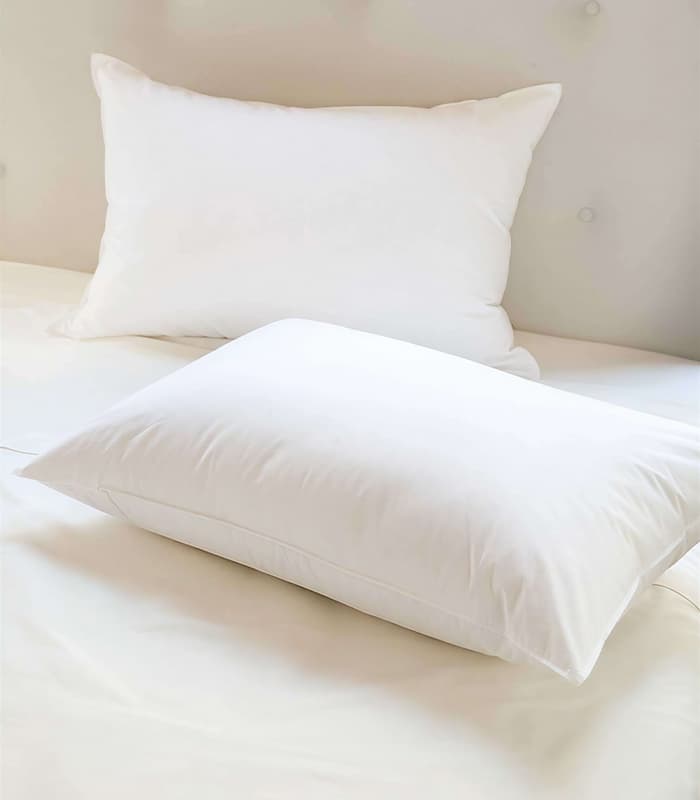
The standard size in Egypt is 50×70cm, which is what off-the-shelf pillowcases are cut for. If your pillow is a different size, make sure the case actually matches it — a loose case lets the pillow slide around all night, and a tight one compresses it and costs you height.
One last thing worth doing: pillowcases get washed weekly, but the pillow itself needs a protector underneath the case. A pillow absorbs sweat and facial oils every single night, and the protector is what genuinely extends its life.
See the pillow range in all three fill weights — every one lists its exact fill weight and dimensions.